
Listening
Why We Started Listening
On the conditions that make trust possible – and why we listen to people who hold space for others.
1 August 2026·4 min read
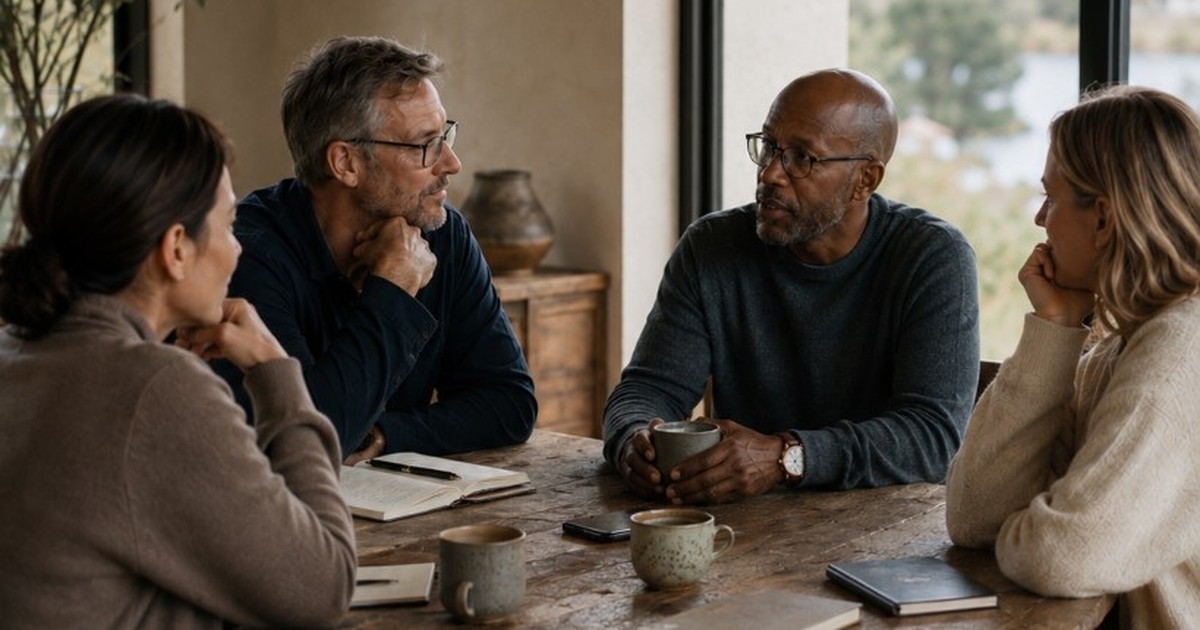
We have come to believe that rebuilding trust may be some of the most important work of our time.
Trust shapes almost everything we do together – how openly we speak, how we navigate differences, what we are able to create together, and how fully each of us can bring our ideas, courage and potential into the world.
And yet trust itself is difficult to create directly. We cannot tell someone to trust us. Nor can we simply measure it, optimise for it and expect it to appear.
So we became curious about a different question:
What makes trust possible?
The conditions around us
Again and again, that question seemed to lead back to the space around us.
Whether we feel heard. Whether we are allowed to arrive without immediately having to perform. Whether there is enough safety to say what we actually think.
Trust seems to emerge from conditions like these.
So then: who already knows how to create them?
The people holding the space
For some, creating these conditions is at the heart of their work.
Facilitators, transformation coaches, event hosts and community builders may spend years learning how to create spaces in which people can connect, reflect, work through difference or change.
But the same capacity can be found in very different worlds.
A CEO creating room for genuine dissent. A teacher making it safe for a student to ask the question they are afraid to ask. A mountain guide sensing what a group needs. A colleague who notices that someone has gone quiet.
Many would probably never describe what they do as “holding space”.
Yet each is shaping, in some way, what becomes possible for the people around them.
When strangers make us feel at home
Travel made us notice this in another way.
Perhaps you have experienced it too: arriving somewhere unfamiliar, surrounded by people you have never met, and somehow feeling remarkably at ease.
Part of this may come from being outside our usual roles. Nobody knows our history or titles. There is less to live up to. Less to perform.
But often there is something else too.
A host welcomes us warmly. A guide makes us feel part of the group. They give enough direction to make us feel safe and enough room to let us be ourselves.
We are far from home, yet somehow we feel at home.
Different worlds, something to learn
The more we look, the more we see versions of this work everywhere.
Some people who hold spaces may be deeply respected within their own communities but rarely heard beyond them – a local host, a guide, a teacher, a community organiser. Others may hold positions that give their voices a wider reach – leaders, entrepreneurs, investors, public figures.
But even when someone’s work is widely known, we usually hear more about what they achieved than about the conditions they created for other people along the way.
How did they earn trust? How did they make room for disagreement? When did they guide, and when did they step back?
The spaces we all create
In different ways, we all shape spaces for one another.
In the way we respond when someone tells us something difficult. In whether we make room for another perspective. In how quickly we fill a silence. In whether the people around us feel they need to protect themselves, or can simply be present.
Perhaps we can all become a little better at it.
For ourselves – and for one another.
It starts with listening
We want to listen to people whose lives and work have taught them something about the conditions that make trust possible.
To hear what they have noticed. What they have learned. What they still find difficult. Where their experiences diverge – and where something unexpectedly resonates.
And, in doing so, to make some of the quieter parts of their work a little more visible.
We start by listening.