
Guidance
When You Don’t Know the Way
What travel can teach us about moving through uncertainty.
25 July 2026·5 min read
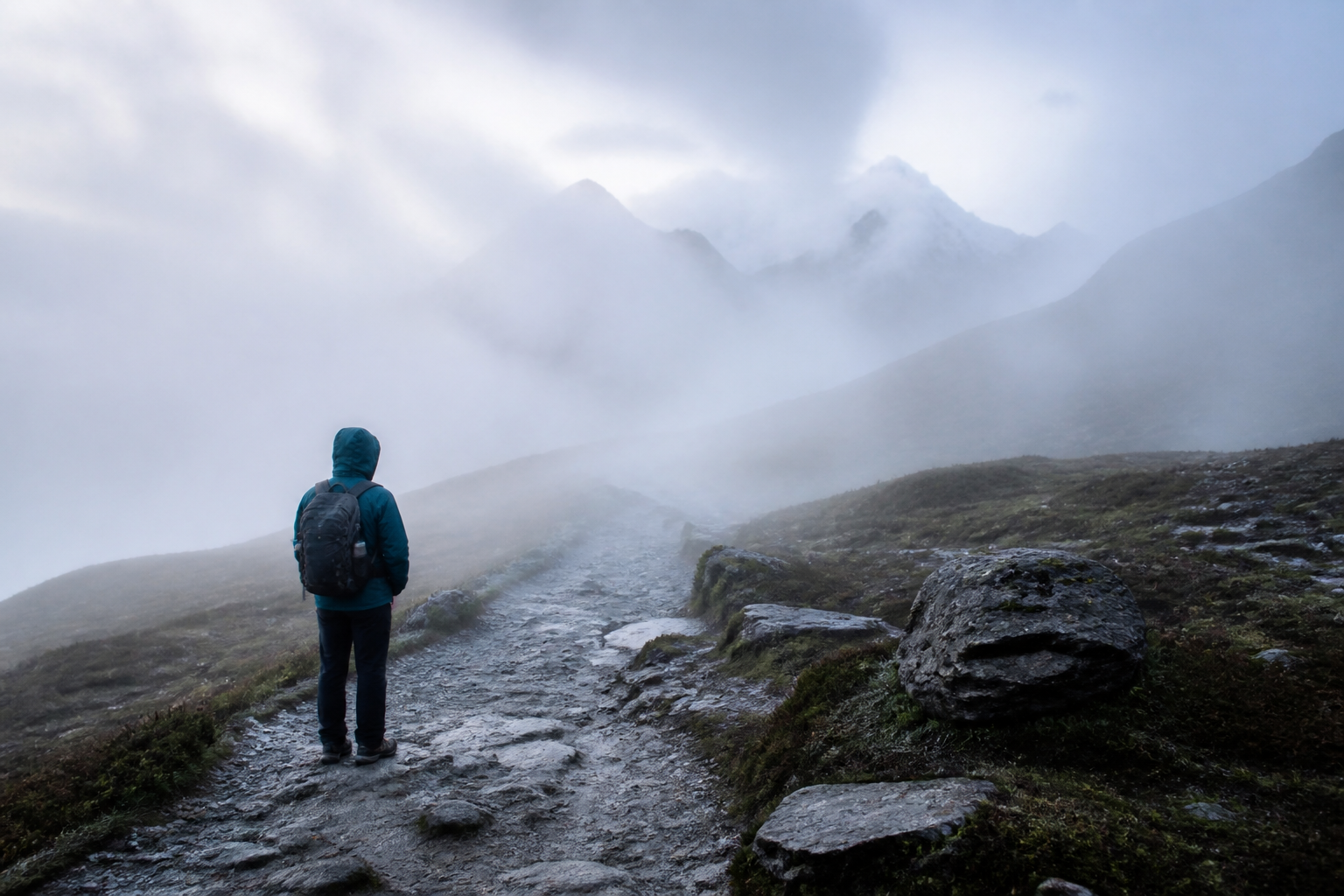
We like knowing where we are going. A destination, a route, a plan. Preferably with an estimated arrival time.
Travel gives us plenty of those: maps, itineraries, reservations, departure boards, carefully researched plans.
And then something changes.
The road is closed. The weather turns. The train doesn’t come. The trail looks nothing like we expected. Suddenly, the plan that gave us confidence a moment ago is no longer particularly useful.
We don’t know the way.
When the plan stops working
Our instinct, when something unexpected happens, is usually to solve it. Check the map again. Search for information. Make another plan.
There is nothing wrong with that. Good planning makes travel safer, easier and more enjoyable.
But sometimes there isn’t enough information yet. Sometimes circumstances are changing faster than the plan can keep up. Sometimes the next step genuinely isn’t clear.
Those moments ask for something different.
Less prediction. More attention.
A map is not the terrain
Anyone who spends enough time outdoors learns this quickly.
The map matters, but so does the weather. The condition of the trail. The energy of the group. The time of day. What happened yesterday may no longer be relevant today.
A good guide doesn’t blindly follow the plan because the plan says so. They look around. They notice what is changing. They interpret what is actually happening and decide what comes next.
Perhaps this is one of the quieter lessons travel can teach us.
When the world becomes uncertain, we don’t necessarily need a better prediction. Sometimes we need to become better at reading what is in front of us.
Someone else may know the way
There is also something deeply reassuring about travelling with someone who knows a place better than we do.
A local guide reads a landscape we barely understand. A driver knows that the road marked on our map hasn’t been usable for months. Someone notices a change in the weather that means nothing to us and everything to them.
We don’t have to know everything ourselves.
In fact, that is part of the freedom of being guided.
We can walk without constantly checking whether we took the right turn. We can look around instead of looking at the map. We can enter somewhere unfamiliar knowing that someone is paying attention to things we cannot yet see.
That doesn’t remove uncertainty. It changes our relationship with it.
When someone else is holding the wider picture, we have more freedom to be present in the one we’re experiencing.
Knowing when to follow
For many of us, allowing someone else to guide us isn’t entirely natural.
We are used to being capable. We research. We plan. We make decisions. We like understanding what is happening.
Travel regularly puts us in situations where our competence becomes contextual.
We may know a great deal about our own world and very little about the one we have just entered.
There is humility in recognising that. Not the humility of making ourselves smaller, but of understanding that someone else can see things we cannot.
Knowing when to lead matters.
So does knowing when to follow.
The next step may be enough
There will still be moments when nobody knows exactly what comes next.
The weather remains uncertain. Circumstances change. Several options seem possible and none comes with a guarantee.
In those moments, we rarely need to solve the entire journey at once.
We need to know enough to take the next sensible step.
We move, and we learn something. The landscape changes. New information becomes visible. From there, another decision becomes possible.
This is how exploration works.
It is also how much of life works.
A different kind of resilience
We often talk about resilience as the ability to withstand difficulty. To endure. To keep going.
But perhaps resilience in an uncertain world looks different.
It is the ability to remain oriented when the route changes. To notice rather than panic. To ask for help. To experiment. To change direction without believing we have failed.
And perhaps resilience isn’t always an individual quality.
Sometimes it comes from knowing that we don’t have to navigate everything alone.
A person who knows the terrain. A community we trust. Someone who can see the wider picture when we cannot. A place where it is safe to admit that we don’t know.
Being resilient doesn’t have to mean being entirely self-reliant.
Beyond travel
Much of life comes with maps: career paths, business plans, strategies, timelines, expectations about how things are supposed to unfold.
They are useful.
Until the terrain changes.
And increasingly, it does.
There will be moments when no amount of planning can give us the certainty we want. Perhaps the task then isn’t to predict the path more accurately, but to become more comfortable sensing our way forward.
Looking around. Listening. Trying something. Learning. Adjusting.
And knowing whom to trust when we need help finding the way.
Travel gives us a surprisingly safe place to practise this. We leave what we know, enter unfamiliar territory and discover, again and again, that not knowing exactly what comes next doesn’t mean we are lost.
Sometimes we are simply somewhere we haven’t been before.
And sometimes, we are fortunate enough to have someone beside us who knows the way.